Henri Fertet
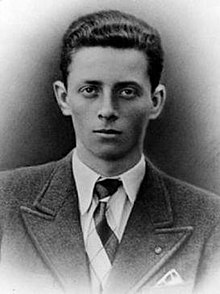
Fertet was born on 27 October 1926 in Seloncourt, Doubs, France, to primary schoolteachers (French: instituteur [fr]). His father too was named Henri; the sources do not record his mother's name. He had a brother, Pierre, who was three years younger. His first schooling was at Seloncourt, where his parents worked. In 1937, the family moved to Velotte in Besançon, where the younger Henri attended the Lycée Victor-Hugo de Besançon. He was determined, lively, intelligent, and affectionate; he was passionate about archaeology and history.
Career
During the school summer holidays of 1942 while World War II was ongoing, he joined a Resistance group in Larnod (near Besançon) led by Marcel Simon, a 22-year-old farmer. In February 1943, that group (which had about thirty members, Fertet being the youngest) integrated itself into the Francs-Tireurs et Partisans (FTP) under the name of Groupe Guy Mocquet [fr].
Groupe Guy Mocquet mounted thirty-one known operations between November 1942 and July 1943. Fertet took part in three of them: on 16 April 1943, a night attack on an explosives depot at Fort Montfaucon [fr]; on 7 May, the destruction of a high-tension electricity pylon near Châteaufarine; and on 12 June, an attack by him and Marcel Reddet on a German customs officer to steal his weapon, uniform, and papers. Fertet shot and fatally wounded the officer, but the unexpected arrival of a motorcyclist meant that Fertet and Reddet failed to seize the documents.
Capture
Groupe Guy Mocquet was then actively hunted down. Several members were arrested in June. In the early hours of the night of 2–3 July, Fertet was arrested at his family home at the Lycée, taken before the Feldkommandantur (a German military court), committed to Butte Prison [fr] in Doubs, held in solitary confinement, and tortured.
On 15 September, twenty-three prisoners from three Resistance groups were brought before Feldkommandantur 560 to answer for crimes of which they were accused. The trial lasted four days. Despite the able advocacy of their lawyers, Paul Koch and Fernand Mouquin, seventeen of them were sentenced to death on 18 September. Simon and Reddet were among them; Fertet was the youngest. Under German law, no-one under the age of 18 could be sentenced to death barring exceptional circumstances. The court ruled that the cases of Fertet (age 16) and Reddet (age 17) were exceptional. The lawyers filed legal appeals; Henry Soum, the préfet of Doubs, Maurice-Louis Dubourg [fr], the Archbishop of Besançon, and the Swiss consul pleaded for general mercy. The sentence of one of the condemned, André Montavon, a 24-year-old Swiss national, was commuted to a term of imprisonment.
Execution and burial
At around dawn on Sunday, 26 September, the sixteen condemned men were told that their appeals had been rejected. They were provided with writing materials and given the opportunity to compose a last letter. They were taken to the Citadel of Besançon and, between 7:36 and 8:25 AM, shot in batches of four. The German officer who commanded the execution party reported that they had all refused blindfolds and died bravely, shouting "Vive la France!"
Eight of the sixteen, including Fertet, were buried in Saint-Ferjeux Cemetery [fr], Besançon. In defiance of German orders, local people covered their graves, identified only by numbers, with flowers. After the war, Fertet's body was exhumed and cremated; his ashes and those of his father, who had died in the meantime, were scattered at Sermoyer, Ain.
Source