Community Manager
Madden NFL 21 Playbooks And AI Gameplay Updates
Hey Madden Fans! We hope you and your loved ones are healthy and staying safe, and we thank you for taking the time to learn about what we have in store for Playbooks and AI-Gameplay Updates in EA SPORTS Madden NFL 21. The game launches worldwide on August 28, 2020.
A major point of emphasis for the gameplay team going into Madden 21 was improving all elements of our run defense. In doing so we also took time to evaluate and make improvements in other areas such as formation alignment, pass coverage, and playbooks.
On offense, we didn’t stop with enhanced user-mechanics. We also spent time improving AI; specifically clock-management, play-calling and adjustments for AI-controlled teams, with the primary goal of making CPU opponents run their schemes more efficiently and effectively.
A variety of enhancements were made to many of our core play concepts to align with our goal to encourage gamers to dig deeper in their playbooks to counter the AI. QB’s and ball carriers that are CPU-controlled got a number of behavioral upgrades that we’re going to tell you about today.
And finally, we’re sharing details about adaptive AI and how it will give you a more authentic gameplay experience vs. the AI.
NFL Live Playbooks 2.0
We introduced the NFL Live Playbooks feature post-launch in Madden 20, which are based on the schemes we see NFL teams execute during the real-life season.
During the 2019 NFL season, we were able to update team playbooks with new content; in previous years, these updates would have had to wait until next year, but NFL Live Playbooks allows for live updates all season long.
Much of the new playbook content got Madden fans excited, including Kansas City Chiefs wide receiver Tyreek Hill. Check out our Gridiron Notes from December 2019 that provides more details on the NFL Live Playbooks including how to access these alternate playbooks.
For Madden NFL 21 we are increasing the amount of content we are delivering via Title Updates. As this feature evolves, it will increasingly become the way we add new playbook content to the game.
We are already in the process of working on new playbook content that will bring even more variety and authenticity to our playbooks. One example of this is the New England Patriots.
The Patriots recently signed QB Cam Newton and as a result, we incorporated more plays into the Patriots NFL Live Playbook to account for Newton’s unique skill-set, which is vastly different than their former QB, Tom Brady.
Offensive Playbook Updates
While the NFL Live Playbooks will evolve and receive the season-long live updates, we’ve also made a lot of changes to our default team playbooks for Madden NFL 21 launch.
The first change you’ll notice is all the NFL Live updates from Madden NFL 20 have been added to all the default team playbooks where applicable. And just like we’ve done previously, all teams with a new head coach or coordinator will have playbook content that reflects the schemes of those specific coaches, based on research like film study and coach interviews.
A contrasting example of this work is reflected when looking at two teams: the Carolina Panthers and the Dallas Cowboys. The Panthers hired a new head coach and overhauled the majority of its coaching staff, so their playbook is quite a bit different since last season; whereas the Cowboys are a bit of an outlier because they have a new head coach, but retained the offensive coordinator.
According to our research, Dallas plans on keeping the previous offense in place, so their playbook for launch won’t look too different. But, once the NFL season starts, if and when we see the Cowboys add some new wrinkles to their offense that we didn’t anticipate, we’ll start adding those to the game via their NFL Live Playbook.
Here a few examples of some of the new plays in Madden NFL 21.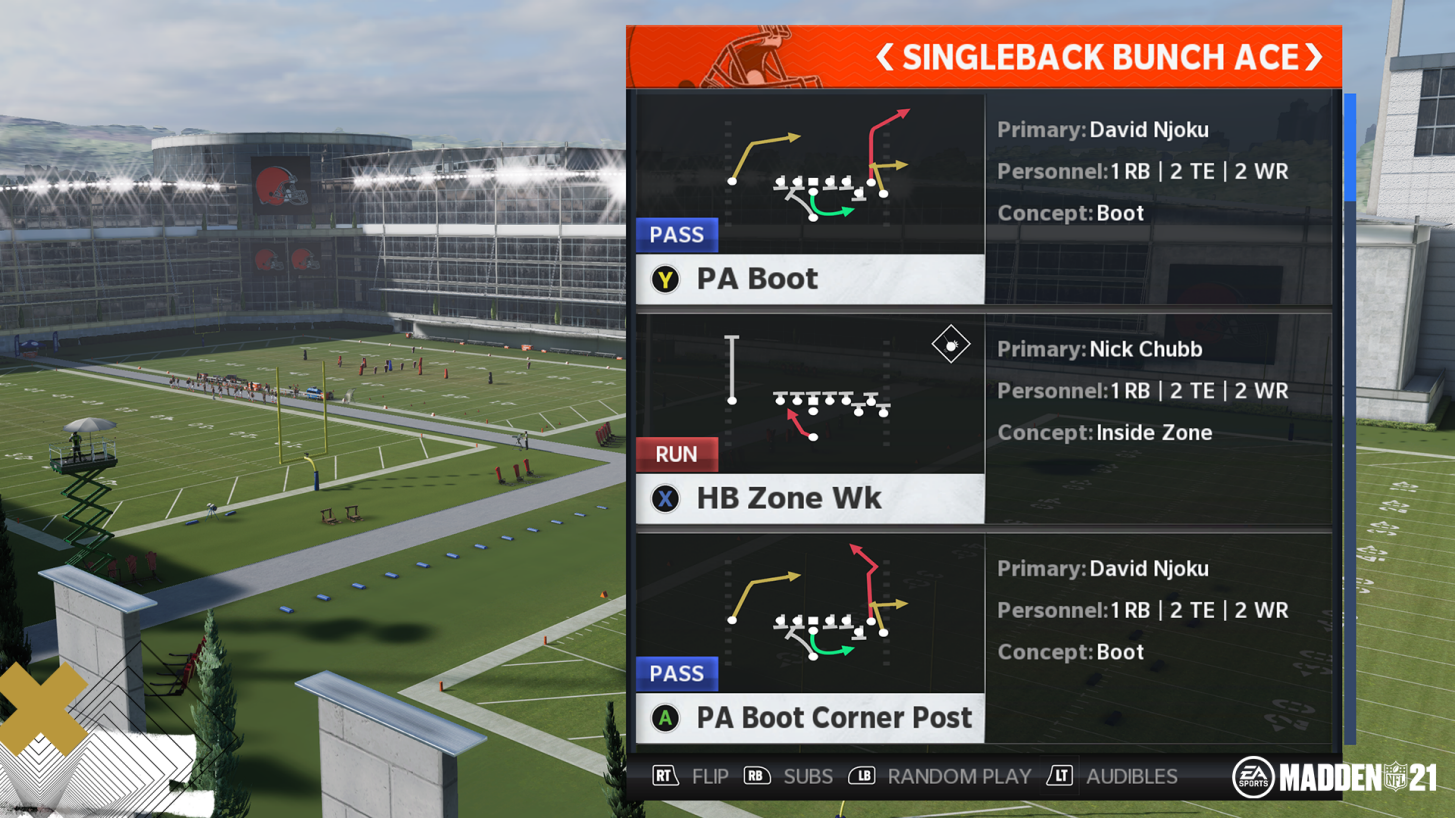
Defensive Playbook Updates
Our main goal for the defensive playbooks was to make them more unique by focusing on including the primary formations that each team uses in real life. This helps ensure that our AI-controlled teams more accurately play to the strengths of their personnel while making each opponent feel unique in their approach.
For example, a team may base out of a 3-4 but they may not have 3-4 Odd in their playbook. Likewise, a team may base out of a 4-3 but may not have 4-3 Normal in their playbook. Users will have more meaningful choices when deciding on a defensive playbook to use this year.
Users will also have more formation and play options available for creating a custom defensive playbook. The new offensive and defensive formations and plays that we added to the NFL Live Playbooks post-launch in Madden 20 have been sprinkled around to various regular team playbooks in Madden 21.
For those not familiar with the new defensive formations that we added late last season to the NFL Live Playbooks, here they are:
Defensive Adjustments to Offensive Motion System
The most fundamental element to playing defense is proper alignment, especially when an offense uses motion or flips the play.
When an offense uses motion it usually results in a change of formation strength, and if a defense does not properly adjust to the formation strength, it could find itself in a vulnerable position.
This was the main contributor to the I-Form Tight ‘motion’ strategy being unbalanced in Madden 20. At the start of the production cycle this year, we identified this area as needing significant improvement and put together a plan of action based on real life football concepts.
The new ‘Adjustments to Motion’ system taps into the logic we use for the Defensive Auto Flip feature. Based on the defensive play-call and the type of offensive motion used, defenses will adjust to the change of strength to maintain proper alignments and run-fit gap integrity by treating the motion the same as an audible.
With this approach getting the defense aligned more appropriately, we can remove some of the motion restrictions we have put in place for formations like I Form Tight that were necessary for game balance.
These adjustments to motions are generally subtle and defenses will seamlessly adjust. If a user prefers to not have their defense adjust to motion in this manner, they can simply turn off Defensive Auto Flip in the front end Settings menu.
Pass Coverage
Another goal on the defensive side of the ball is bringing more balance to man coverage. We first made improvements to the ‘press-man’ interaction system. Defenders will use more appropriate press-man animations that scale per the matchup of the defender’s Press (PRS) rating vs. the receiver Release (RLS) rating.
In Madden 20, lower-rated defenders were too successful at winning press interactions. Defenders in Madden 21 can now get faked out by certain wide receiver releases. This allows more animation content in these situations and will for more separation off the line of scrimmage vs. outmatched defensive backs.
We also tuned man-coverage so that receivers with a higher Route Run rating (SRR, MRR, DRR) vs. the defender’s Man coverage rating (MCV) will have a slightly higher chance of winning on certain route cuts down field. These principles also apply to many of the match-zone coverages, such as Cover 4 Quarters/Palms vs. Trips formations.
General Play Tuning
We made many subtle improvements to a number of legacy plays for Madden NFL 21. These improvements will encourage users to change-up their play-calling and execute more plays that you may have avoided in the past.
As mentioned in our Gridiron Notes Gameplay Deep Dive we tuned the speed of many of our handoff animations so that handoffs are the same speed going in either direction.
We also changed how block-shedding works defensively in relation to the handoff speeds: block sheds will be better timed to match the point at which the ball carrier is out of the handoff animation and deciding which gap to run through.
These two changes have made more running plays reliable options in the ground game, while also bringing balance to overused plays, such as stretch and dive.
Before the snap, we updated animations used for pre-play motion; both for auto-motion and manual motions. These new animations allow players to move realistically and athletically when in transition from one alignment to another.
The motion movements are also contextually appropriate based on the player-position (wide receiver, tight end, halfback, etc) while considering the type of play and formation in which the motion is used.
We added more variety in receiver stance animations which account for the receiver’s body type. Along with the new stance, we cleaned up some issues with releases into their routes when not being pressed to get them into their routes and downfield faster to improve the timing of the passing game.
HB Slip Screen plays have been adjusted in many areas. The first is the halfback getting a cleaner release on his route, while avoiding traffic near the line of scrimmage.
We also added functionality for the screen blockers to sometimes block a rusher in the inside gaps before releasing out for the screen so that the QB has enough time to get the pass off vs. heavy pressure.
In addition to the HB improvements to screen passes, another new addition is HB Choice routes, which will be commonly used in trips formations, like Gun Trey Y Flex.
These routes get your halfback involved in the passing game and allow him to make AI-driven decisions on the fly. And even HB Swing routes have been tuned so that the running back is more aware of the sideline and more responsive in turning up the field after the catch.
For WR screen plays, such as PA Jailbreak Screen you’ll notice that receivers can immediately get up the field after catching the ball. And QB’s can now get the ball out much quicker, as you can immediately abort any play-action fake at any time by pressing the receiver icon to throw. This feels similar to RPO alerts from Madden 20.
Speaking of RPOs (Run-Pass Option), we continued polishing them after introducing them last year. On some of the RPO Peek plays, the running back will take more of an inside zone track because this path of departure makes the weak-side running game, away from the tight end, more powerful.
AI Play Calling and Clock Management
Play-calling and Clock Management by AI-controlled teams was something we spent a lot of time refining for Madden NFL 21, primarily to make each game inside of Franchise modes and Ultimate Team Solo’s feel more unique and strategic.
AI-controlled teams will mix-up a more diverse set of pass concepts so they are less predictable and more aggressive. To pay this off, we also tuned the AI-QB pass read progressions so that they are more likely to throw to their best receiver in critical situations and/or when there’s not an obvious open receiver.
The AI-QB will also do a better job of coverage recognition by anticipating receivers coming open and throwing the ball before they cut on certain routes. And lastly, AI-QB’s will be more intelligent in making reads for RPO plays and throwing the ball on-time when pulling it to pass.
On defense, in goal line situations, the AI play calling will be much more dynamic now - meaning they won’t always come out in the perfect personnel package based on the offensive play call - which will make you get a little more creative on offense if you want to score.
For clock-management, AI-controlled teams will be smarter in handling end-of-half and end-of-game situations. The AI will better utilize the game-context to make decisions, such as current score, quarter, play clock, and remaining timeouts when deciding what to do in these critical situations.
AI-teams will be better at using their timeouts like a user would when trying to get points at the end of the half. They will also have a greater sense of awareness of current game conditions when deciding between going for it or kicking on fourth downs. And when the game is on the line and the AI absolutely must get a score to win, the QB’s will be aggressive in throwing into coverage and utilizing mismatches.
Adaptive AI and AI-Quarterback Updates
Once an NFL quarterback gets to the line of scrimmage and scans the defense, he has the option to audible to a play he feels is good vs. the current defensive look. In Madden NFL 21, we’re refining our adaptive AI logic, which will give AI-quarterbacks the ability to audible to pass concepts that are ideal for attacking certain defensive coverages.
This logic will begin to take place after repeated defensive play calls. The AI quarterbacks are much better equipped to deal with all-out blitz plays and, in some situations, will change the protection by keeping the halfback or tight end in to pass block.
Make sure you use a variety of defensive plays against AI opponents, or they will start making adjustments to counter; this will drastically improve the strategy in solo game sessions, such as single-player Franchise and MUT Solo’s and make it more difficult to exploit the AI by repeatedly running plays such as Double A-Gap Mid Blitz.
When facing pressure, the AI quarterbacks will play more true to their style of play. For example, a scrambling quarterback will look to run with the ball if they can find an open running lane.
A pocket-passing quarterback will look to throw the ball away more when feeling under pressure or even take those 1-on-1 shots down the field to favorable matchups.
Playing against Lamar Jackson compared to Tom Brady is a completely different experience this year, so be prepared to game plan accordingly.
The pressure recognition by the AI quarterbacks will scale by difficulty level, meaning on higher difficulties like All-Pro and All-Madden, it will become harder to get to the QB for a sack before he throws the ball.
AI-Ball Carrier Updates
For Madden NFL 21 AI-controlled ball carriers have also seen improvements. AI-controlled halfbacks are more decisive in their decision to pick a running lane and have a more organic behavior in the open field. The AI quarterbacks will look to protect themselves and the ball in a realistic way by sliding in the open field or running out of bounds.
We hope you’re enjoying Gridiron Notes as we move closer to the launch of Madden NFL 21. We look forward to adding more playbook content in future updates, as well as continued support on AI gameplay post-launch. Of course, there’s still so much to share with you so check out when the next Gridiron Notes is coming below!
WHAT’S NEXT?
Our next Gridiron Notes will be on Tuesday, July 28th and will focus on your feedback from the Madden NFL 21 Closed Beta.
(Source)