dogheels wrote:Offsides. Too many missed or improperly interpreted. Icing calls. Too many non calls, especially against the AI.
Offsides and icing aren’t being interpreted by a ref the way they are in real life.
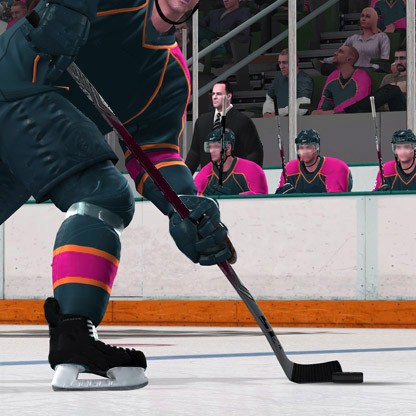
The rink is basically a grid, the lines are exact coordinates, and the players and puck are objects with precise positions. When the puck crosses a line, the game just checks where everything is at that moment. If a skate is already over the blue line, it’s offside. If the puck meets the icing conditions, icing triggers. No interpretation involved.
That’s why some calls feel harsh or “wrong.” In a game, being over the line by a tiny amount is still over the line. The math doesn’t care how close it looks.
So when something looks questionable, it’s usually animations or camera angles not lining up perfectly with the underlying logic.
Basically: the game isn’t judging the play. It’s just doing math, every frame, and enforcing the rules exactly as coded.
dogheels wrote:Use to be a viable defensive tactic, but now, its almost impossible to apply.
I think this gets overstated. I’ve shared plenty of clips showing poke checks working exactly as intended when they’re timed and positioned properly. To me, it feels like the poke-check logic shifted toward requiring more deliberate, skill-based use. For years, players were conditioned to rely on it as a bailout, and now there’s frustration that it doesn’t function that way anymore.
Could it be adjusted or made more forgiving? Maybe. Personally, I don’t think it needs a buff, but it’s obvious there’s a segment of the player base that struggles with it in its current state. I’d hate to see it revert to a crutch for poor positioning, but I do understand why some players want a bit more margin for error.
dogheels wrote:If these small things could be addressed and fixed. The game would start an upward spiral, rather than the downward one its on now.
I get the frustration, but I think calling the series “in a downward spiral” is overstating it.
When you look at things like LG still running at scale, the sheer number of active EASHL teams, and how many people are clearly deep into HUT, it’s hard to argue the franchise is collapsing. That doesn’t mean every design or gameplay choice is landing for everyone. It’s totally fair to say certain changes don’t line up with your personal tastes, but that’s different from the whole series being in free fall.
What I see is a dev team trying to keep NHL relevant in a pretty brutal multiplayer landscape. Most modern games are built around individual expression, progression, and instant feedback. NHL, by its nature, is a team sport, and they’re trying to balance that while also keeping the game accessible, competitive, and fun year over year. That’s not an easy needle to thread.
On top of that, there’s always tension between realism and playability. Hockey doesn’t always translate cleanly to a controller, and sometimes what feels like it should work based on real world hockey knowledge doesn’t map perfectly to stick inputs, timing windows, and in game systems. When those two things don’t line up, it’s easy to conclude the game “isn’t realistic anymore,” even when the underlying issue might be execution rather than intent.
I also think there’s a tendency for players to assume hockey IQ alone should carry them. When that knowledge doesn’t fully translate into thumbstick skill, positioning, or timing, the blame often shifts to the game instead of the learning curve. That doesn’t mean all criticism is invalid (far from it) but it does complicate the idea that fixing a handful of “small things” would suddenly reverse the direction of the entire franchise.
So yeah, there’s room for improvement, always. I just don’t think the evidence supports the idea that NHL is spiraling downward. It looks more like a game constantly negotiating between competing expectations in a changing multiplayer world.