As someone who's been tinkering with computers for over 35+ years, since the days of floppy disks and DOS prompts, I wholeheartedly embrace Secure Boot and other secure methods in video games. This technology is a critical step toward a cleaner, fairer, and more secure gaming ecosystem. For too long, cheaters, trolls, and script kiddies have plagued online gaming, turning competitive matches into frustrating cesspools of unfair advantages. Secure Boot is a line in the sand, and I'm here to tell you why it's worth defending.
Let's be real: the loudest critics of Secure Boot often fall into a few predictable camps. First, you've got folks who treat their PCs like glorified consoles, prebuilt rigs used solely for gaming, with little understanding of what's under the hood. They're not wrong to enjoy their games, but their lack of technical know-how makes them wary of anything that sounds complicated. Then there are those who, let's say, aren't exactly winning any intellectual marathons, folks who see Secure Boot as some shadowy conspiracy rather than a straightforward security measure. And finally, the most vocal group: cheaters and trolls who rely on exploits to ruin everyone else's fun. If you're in this last group, sorry, but your days of unchecked chaos are numbered.
Secure Boot isn't just a random tech buzzword; it's a foundational security feature that ensures your system boots only trusted software. By verifying the integrity of your operating system and drivers, it prevents malicious code, like cheat software or kernel-level hacks, from loading before your game even starts. This is a game-changer for online gaming, where cheating has become an epidemic. From aimbots in Call of Duty to wallhacks in Valorant, cheaters have been thumbing their noses at fair play for years. Secure Boot is the industry's way of saying, enough is enough.
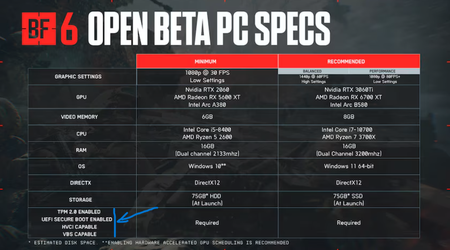
Developers like EA and others are stepping up, requiring Secure Boot for games like Call of Duty and potentially even Arc Raiders. This isn't about locking you out of your PC; it's about locking out the bad actors who've been dodging bans with custom kernels and rootkits. If you're a legitimate player, Secure Boot is your ally, not your enemy.
To address the vocal minority whining about Secure Boot, let's dive into specific complaints from official forums and Steam discussions, as seen in recent posts, and set the record straight.
Some users claim that enabling Secure Boot, especially when switching from legacy to UEFI, can render their PC unusable or require a full Windows reinstall, wiping all data. One Steam user warned, "I've read about a lot of people being unable to run their PC again while trying switching from legacy to UEFI and enabling Secure Boot for BF6." Another added, "You have to save ALL your stuff first, and then, if you're unlucky, setup your whole PC again."
Rebuttal: This fear is overblown and often stems from misinformation or improper execution. Enabling Secure Boot doesn't inherently brick your PC. For most modern systems (any motherboard from the last decade), switching to UEFI and enabling Secure Boot is straightforward and doesn't require a full reinstall if done correctly. Tools like Microsoft's mbr2gpt.exe allow you to convert your disk from legacy to UEFI without data loss, as outlined in Steam discussions. If you're on Windows 10 or 11, Secure Boot is fully supported, even on LTSC IoT versions. The key is to follow proper guides, like those from EA or Dell, which walk you through checking BIOS settings and enabling Secure Boot safely. Back up your data as a precaution, but the idea that Secure Boot destroys your PC is a myth not grounded in reality for most users.
Some forum and social media users argue that Secure Boot is ineffective, claiming, "Most malware and even the cheats can and do bypass it with ease," or "Secure Boot has already been bypassed by malware companies." They suggest it only inconveniences legitimate players while cheaters find workarounds.
Rebuttal: While no security measure is 100% foolproof, Secure Boot significantly raises the bar for cheaters. It prevents unsigned drivers and malicious code from loading during the boot process, which is a common vector for kernel-level cheats. Anti-cheat systems like EA's Javelin rely on Secure Boot to ensure a trusted environment, reducing the attack surface for exploits. The claim that cheats easily bypass it ignores the fact that bypassing Secure Boot requires sophisticated skills and resources, far beyond the average script kiddie's capabilities. Data from anti-cheat providers like BattlEye shows that kernel-level exploits are a primary cheating method, and Secure Boot directly counters these. By dismissing Secure Boot, critics are essentially arguing against any security measure because "hackers will always find a way," which is a defeatist attitude that benefits cheaters.
Another common gripe is that Secure Boot kills Linux and Steam Deck support, with one social media user stating, "Anti-cheat would remove any ability to play on Linux if we wanted to." Others claim it restricts dual-boot setups or unsigned drivers.
Rebuttal: This is a valid concern for a small subset of users, but it's not a dealbreaker. Many Linux distributions, like Ubuntu and Fedora, support Secure Boot with pre-signed keys, and users can enroll their own keys for custom setups. Yes, Steam Deck and Linux gaming face challenges with kernel-level anti-cheats, but this is a trade-off for ensuring fair play in multiplayer environments. Developers prioritize the majority of players on Windows, where cheating is most prevalent. If you're dual-booting, modern motherboards allow you to save BIOS profiles, making it easy to toggle Secure Boot on and off for gaming sessions. The inconvenience is minimal compared to the benefit of a cheat-free experience for millions of players.
Some players complain that enabling Secure Boot is too complex, with one Steam user saying, "I'm not a cheater, but I don't plan on changing system settings just to run one **bleep** game." Another social media post noted, "I dont think its hard to do at all but for instance my mobo had it enabled but it was bugged which is common."
Rebuttal: Enabling Secure Boot is not rocket science. It typically involves entering your BIOS (by pressing a key like Del or F2 at startup), navigating to the boot settings, and toggling Secure Boot to "Enabled." EA and Dell provide step-by-step guides that make this accessible even for casual users. If your motherboard has a bugged implementation, that's a hardware issue, not a flaw in Secure Boot itself, and firmware updates often resolve this. The effort to enable Secure Boot is a one-time task that takes less time than installing a game patch. Refusing to do it because it's "too hard" is like refusing to update your graphics drivers, it's a basic part of maintaining a modern gaming PC.
Beyond these specific complaints, some argue broadly that Secure Boot limits their freedom or that server-side anti-cheat solutions are better. Freedom to run unsigned drivers or custom OS setups is important for enthusiasts, but in a multiplayer context, your freedom ends where it harms others. Cheaters exploit that freedom to load malicious code, ruining matches for everyone. Server-side anti-cheat, while useful, can't catch kernel-level exploits that manipulate the game client before it even connects to the server. Secure Boot complements these solutions, not replaces them.
To the "it's too hard" crowd: if you can build a PC or install a game, you can handle Secure Boot. It's a few clicks in BIOS, and developers are providing clear instructions. The real inconvenience isn't enabling Secure Boot, it's dealing with cheaters who ruin your matches because they bypassed basic security measures.
Owning a PC isn't just about plugging in a box and clicking play. It's about taking responsibility for your system and its impact on others. Every time you fire up a multiplayer game, you're not just playing for yourself, you're part of a community. Cheaters don't just hurt you; they hurt everyone who's trying to enjoy a fair match. By leaving Secure Boot enabled, you're not just protecting your rig; you're protecting the integrity of the games we all love.
To the naysayers: if you're abandoning ship to games that don't require Secure Boot, good luck. The industry is waking up. More developers are adopting this standard, and soon, you'll be hard-pressed to find a major title that doesn't enforce it. Why? Because players are fed up with cheaters, and developers are listening. The data backs this up, studies from anti-cheat companies like BattlEye and Easy Anti-Cheat show that kernel-level exploits are a primary vector for cheating. Secure Boot slams the door on those exploits.
It's time to stop whining and start winning, fairly. Secure Boot is a small price to pay for a gaming world where skill, strategy, and teamwork matter more than who can download the best cheat engine. To every gamer out there: take the five minutes to enable Secure Boot, secure your machine, and stand with developers who are fighting the good fight. Let's make cheating a relic of the past and build a future where every match is a fair one. The cheaters had their run, it's time to boot them out for good.

 7 months ago