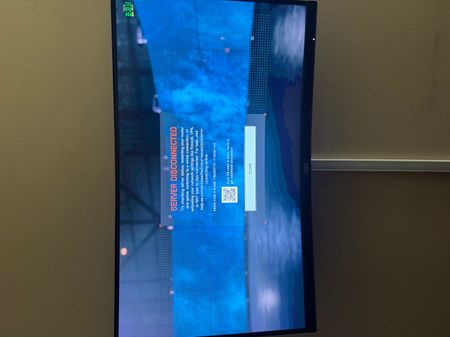
Game is absolutely unplayable on EA servers
Battlefield 6 Official Servers Bug Report System Device: GMKtec NucBox M7 Pro CPU/APU: AMD Ryzen 9 PRO 6950H with Radeon Graphics GPU: Integrated Radeon 680M-class graphics on the 6950H APU Display: Dell S3222DGM via DisplayPort Resolution / refresh normally used: 2560x1440 at 144 Hz Connection: Wired Ethernet OS: Windows 11 25H2 BIOS observed during testing: NucBox M7 Pro 1.01 Problem Summary Official EA Battlefield 6 servers become unplayable, while Battlefield Portal servers and Fortnite run normally on the same PC and same connection. Symptoms on official servers TN rises into the hundreds or thousands of milliseconds Severe stuttering / rubberbanding Character movement becomes difficult or impossible Sometimes the game eventually crashes Task Manager may show CPU speed collapsing to very low values during the failure Real ping remains normal while TN explodes Observed metrics during failure Latency stays around 19 ms Packet loss stays at 0% TN has been observed around 384 ms, 1,877 ms, and roughly 1,996 ms In the worse state, the game can become effectively frozen and then crash Important contrast Battlefield Portal: works normally / smoothly Fortnite: works normally Official Battlefield servers: unplayable This appears to be specific to the official-server path, not general PC performance or general internet connectivity. What was tested Wired Ethernet connection Traceroute / route to EA appeared normal Packet loss remained 0% FSR disabled Frame generation disabled Future frame rendering disabled Game repaired IPv6 tested Fullscreen optimizations disabled Windowed mode tested Borderless tested Fullscreen tested V-Sync tested off Local Battlefield settings/profile files reset and rebuilt EA Javelin anticheat reinstalled BIOS performance mode tested Results of testing Windowed mode improved the issue somewhat, but I do not want to play in windowed mode Borderless is somewhat less bad than fullscreen, but still broken on official servers Fullscreen and borderless can both trigger the issue Changing BIOS to Performance mode did not fix the problem and seemed to make it worse Reinstalling EA Javelin anticheat did not fix the problem Resetting Battlefield config files did not fix the problem The issue remained limited to official servers Why this does not look like a normal network issue Real latency remains low and stable Packet loss remains 0% Portal and Fortnite work fine on the same machine and same connection TN rises dramatically only in the broken official-server scenario Why this does not look like a general PC failure Other games work Battlefield Portal works The failure pattern is specific and reproducible on official servers The issue survives game repair, config reset, anticheat reinstall, and multiple display-mode tests Request Please investigate this as an official-server or official-server-client-path issue affecting this hardware/software combination, especially on AMD APUs such as the Ryzen 9 PRO 6950H / Radeon integrated graphics class. Suggested areas to investigate Official-server-only regressions versus Portal TN spikes with normal latency and zero packet loss Client stalls related to official-server backend activity Interaction with EA Javelin anticheat on official servers AMD APU / presentation / fullscreen-borderless behavior on official servers Any Season 3 regression affecting AMD integrated graphics or Ryzen 6000-series APU systems Repro summary Launch Battlefield 6 on this system. Join an official EA server. Observe TN rapidly rising while normal ping remains low. Game becomes severely stuttery or unplayable. In some runs, the game crashes. Join Portal on the same PC/connection and the issue does not occur. Please treat this as a reproducible official-server issue rather than a general connection problem, because the behavior differs sharply between official servers and Portal under the same local conditions.75Views0likes6Comments
TÓPICO 3 — Server Health & Server Browser
Título Metrics Texto pronto para postar Technical Proposal: Server Health Telemetry and Smarter Server Browser Quality Metrics The upcoming Server Browser is an opportunity to provide more than a list of servers and ping values. Ping tells the player how long packets take to travel. It does not necessarily describe the health of the server simulation itself. 1. Separate Network Latency From Server Health A player could theoretically have excellent latency to a server that is experiencing simulation pressure. Likewise, a healthy server can still feel poor when the player's network route is unstable. Internal diagnostics should separate these conditions. 2. Server-Side Health Telemetry Potential internal metrics could include: Server simulation frame time. Tick/simulation stability. CPU utilization. Networking workload. Replication workload. Entity count. Physics workload. Packet-processing queues. Player count. Abnormal simulation overruns. 3. Server Quality Index The Server Browser could potentially expose a simplified quality indicator rather than overwhelming players with engineering statistics. For example: Excellent Good Degraded The underlying calculation could consider server and connection health without exposing sensitive infrastructure information. 4. Region Transparency The browser should clearly identify the hosting region. This would allow players to understand why one server has significantly different latency from another. 5. Persistent Match Flow If players decide to stay with a good-quality server after a round, the system should preserve that experience wherever practical. Avoiding unnecessary server reassignment can provide consistency for groups that already found a stable match. 6. Automatic Server Health Detection If telemetry detects severe server degradation, the backend could investigate whether that instance should stop accepting new players or eventually be recycled. The objective would be to prevent degraded instances from remaining in circulation for extended periods. Engineering Metrics Server simulation P95/P99. Server simulation overruns. Connection-quality distribution. Server CPU saturation frequency. Unexpected disconnect rate. Server instance failure rate. Abnormal match termination rate. Average session duration. Percentage of healthy versus degraded instances. Final Objective The Server Browser should become more than a server list. It could become part of Battlefield's reliability architecture. Players would gain clearer information before joining while developers gain better visibility into where server degradation occurs. This would help distinguish three different problems: client performance, network-path quality and server health. Treating those independently would make troubleshooting and optimization considerably more precise. A EA já confirmou que o Server Browser será testado e que o matchmaking continua sendo investigado, inclusive por partidas de ping alto.TÓPICO 2 — QoS Matchmaking
Título Battlefield 6 – QoS-Aware Matchmaking & Datacenter Selection Texto pronto para postar Technical Proposal: QoS-Aware Matchmaking and Datacenter Selection Matchmaking quality should not be evaluated by queue time or skill parameters alone. For a competitive multiplayer FPS, network quality is part of match quality. The Battlefield team has already acknowledged concerns involving players being placed into high-ping matches. For Season 5 and beyond, I would suggest evaluating a more network-aware matchmaking architecture. 1. Pre-Match Datacenter Measurements Before matchmaking completes, the client could periodically measure connectivity to available Battlefield regions. Rather than relying on a single ping measurement, several lightweight UDP samples could be collected. This would create a more realistic picture of the route between the player and each available region. 2. Measure More Than Average Ping The system should consider several network characteristics: Latency. Latency variation/jitter. Packet loss. Measurement stability. Regional availability. Recent connection history. A connection with 45ms latency but severe jitter may provide a worse gameplay experience than a stable 55ms connection. 3. Regional QoS Ranking Available datacenters could be ranked according to measured connection quality. Matchmaking would then attempt to place players in the best available region while balancing: Connection quality. Population. Party requirements. Match quality. Queue time. Game mode availability. 4. Controlled Fallback If the preferred region cannot produce a match, matchmaking could gradually expand its acceptable region or latency range. However, that fallback should be visible and measurable rather than silently placing a player into a dramatically worse connection. An optional message could indicate: “Expanding matchmaking region to reduce queue time.” This gives players transparency. 5. Party-Aware Network Evaluation Parties containing players from different geographic areas require special handling. The system could evaluate the combined QoS profile of all party members and select the region providing the best overall compromise instead of optimizing for only one member. 6. Persistent QoS History Short-term connection anomalies can distort a single measurement. Using a rolling history could allow matchmaking to distinguish between: A temporary spike. Persistent high latency. Unstable routing. Consistent packet loss. A recently degraded ISP route. Measurement EA/DICE could track: Assigned match latency P50 / P95 / P99. Percentage of players assigned outside their preferred region. Jitter distribution. Packet-loss distribution. Matchmaking fallback frequency. Queue time versus network-quality tradeoff. Disconnect rate per datacenter. Player retention after high-latency matches. Server Browser Integration The upcoming Server Browser creates another opportunity. Players could see clear network quality indicators before joining: Region. Ping. Connection-quality estimate. Potentially packet-loss or stability warnings where appropriate. Final Objective Battlefield should attempt to place a player not simply into an available server, but into the best realistically available network path. The objective is not zero latency. The objective is predictable, transparent and measurable network quality. For Battlefield 6, matchmaking quality and network quality should be treated as interconnected systems. A Microsoft multiplayer architecture example documents UDP QoS probes and using measured player latency to rank server regions, so this proposal is technically grounded without implying EA needs to use Microsoft's specific implementation. � A EA is currently investigating high-ping matchmaking and plans Server Browser work for Season 5.
"Kicked for Inactivity"
PC, I can't even get into a match. Game acts like it's searching for a match, and the search progress bar gets a bout a quarter of the way out and then the entire application freezes. Less than a minute later I'm hit with "You were kicked for inactivity." This has been multiple days and multiple attemps at getting into a match a day. I've deactivated FRS in graphics and still can't get into a match. I've restarted my router, I've restarted my PC, I've cleared my cache, I've verified game files, I still can't get into a match. I can't get a hold of ANYONE at EA. This has only happened after they started requiring SecureBoot to play any of their content. Spent $60 on a game and I can't even play it.Trash Servers
(My xbox is connected to my router with an ethernet cable ) I’ve been in 10-15 matches today and only one had a good connection. 2 of the matches crashed completely for everyone playing. The rest was lagging throughout the entire match (which did not last very long due to my team skipping across the map continuously). This is getting ridiculous. Take some of those millions of dollars you have made from this game and fix your servers.20Views0likes0Comments
Using distant servers for Ranked BR
Hi. Most time of the days when trying to enter Ranked BR I'm redirected into a server from another country, always at 130-170ms (which once came to 600ms!). I'm only able to join Brazilian servers when it's night, when most BR players are on the game. However, this latency makes the gameplay very complicated and this interval is usually decisive in combat. This matchmaking system inherited from Firestorm was never ideal. Instead, players should be allocated in servers only from their nearest areas, and these servers should be fulfilled with people from their region before starting a match, even if it takes more time than the usual. I assume that it's better to have a playable match (but longer waiting) than getting set into a match quickly to join an unplayable match. On Firestorm it was a mess, with Redsec you guys could try this new approach. Thanks for the attention. PS: Separating PC players from Console players would be nice as well, the gameplay is never the same level, although it's welcome as a last resort and/or to join friends.40Views0likes2Comments
Lagging, Network Issue or BF6 Issue??
Hello, I get this about once a day. It is usually accompanied by packet-loss on the top left of the screen with a %25 or another value. If i am in chat, whether its Discord or in-game, my buddy's will say that i sound robotic. It is also, accompanied by lagging, rubber-banding. I have no idea what's causing this.. i reset my modem/router weekly. It makes me think its not a BF6 issue, because of the audio distortion in Discord. I also, do not currently play any other games, so i do not have anything to compare it to. Anyone have an idea of what's going on? This issue isn't exactly game-breaking, because for the most part i do not get "server disconnected", but i do notice it happens several times during a 2-3 hour gaming session. Any help would be great.. thanksFix the game properly please!!
Fix the all the issues! I believe you over powered all weapons. The game is comepletely Rigged from all servers!! How are the people supposed to enjoy the game if you keep messing with certain stuff. Make the game equal its not that hard!! The hit marker are way off. Everytime I turn off auto assist, it goes back to auto assist mode which is stupid. You guys can do better than this crap!! Fix the ranking its total **bleep**!!!7Views0likes0CommentsBattlefield 6 Technical Readiness Report Season 4 Season 5
The objective of this report is to consolidate persistent technical issues identified throughout Battlefield 6 up to and including Season 4, providing the development and QA teams with a structured overview of problems that may still require investigation or further optimization.Any FPS, frame-time, latency, server-performance, or stability metrics mentioned in this report should not be interpreted as fabricated or guaranteed performance gains. The purpose of these metrics is to propose measurable technical indicators that EA and Battlefield Studios can validate internally through controlled testing, profiling, and telemetry.Before the release of Season 5, I respectfully recommend conducting a comprehensive Technical Readiness Pass across performance, networking, server stability, rendering, frame pacing, memory utilization, asset streaming, audio, physics, UI, and overall game stability.For greater transparency, remaining issues could be classified using clear development statuses such as: FIXED /PARTIALLY FIXED / INVESTIGATING /REPRODUCED.The goal is not simply to achieve higher FPS, but to establish a more stable, consistent, responsive, and technically reliable Battlefield 6 experience before Season 5 introduces additional content and systems. Platform: PlayStation 5 Current reference version: 1.4.2.5 Period covered: Battlefield 6 launch through Season 4 Report date: September 11, 2026 I am submitting this as a consolidated technical report rather than an isolated bug report. Battlefield 6 has received numerous fixes since launch, including the Season 4 updates, but there are still technical inconsistencies reported by PS5 players that deserve further investigation. 1. Performance consistency / frame-time Please investigate frame-time consistency on PS5, particularly during intensive multiplayer situations. Average FPS alone does not represent the entire performance experience. Short frame-time spikes can create visible stutter and inconsistent controller response even when the reported frame rate appears acceptable. Expected behavior: Performance Mode should prioritize stable frame delivery and consistent input response throughout a match. Suggested investigation: CPU/GPU frame-time telemetry during large engagements, destruction, vehicles, water simulation and high-player-density situations. Potential benefit: More consistent frame pacing would improve perceived smoothness and input responsiveness without necessarily requiring an increase in the maximum frame-rate target. 2. Dynamic Resolution Scaling / Performance Mode reliability Earlier Battlefield 6 known-issues documentation acknowledged that Dynamic Resolution Scaling on consoles was not operating as intended in Performance Mode and could require Performance Mode to be toggled again after entering a session. Please verify that DRS activation and its state remain completely reliable across matchmaking, returning to the main menu, changing servers/maps and extended play sessions. Expected behavior: The selected performance configuration should remain active automatically for every session. Potential benefit: Correct DRS behavior can allow the renderer to reduce GPU workload during demanding scenes rather than allowing GPU pressure to translate into unstable frame delivery. 3. Network/server performance warnings and perceived lag Season 4 PS5 players have continued reporting lag and in-game performance/network warnings. This does not establish that every occurrence is server-side, but the reports justify additional telemetry-based investigation. Please examine server frame-time, packet delivery consistency, packet loss, jitter and client/server synchronization during high-load situations. Expected behavior: Stable simulation and predictable network synchronization throughout a match. Potential benefit: Improved server consistency could reduce situations perceived as delayed movement, inconsistent interactions or sudden corrections. 4. Vehicle third-person camera instability Battlefield communications acknowledged a third-person vehicle camera issue where the camera could suddenly jump or snap while driving. This should be treated as more than a visual inconvenience because sudden camera displacement can interfere with aiming, spatial awareness and perceived input consistency. Expected behavior: Camera movement should remain continuous and correspond predictably to player input and vehicle movement. 5. Ping/spotting reliability Battlefield communications previously acknowledged that pings might fail to appear correctly, particularly while players were using vehicles or drones. Please verify this system under current Season 4 conditions and across different modes. Expected behavior: Successful player inputs should produce consistent visual/network feedback for the squad. 6. Collision and geometry anomalies Season 4 PS5 community reports have described situations involving players passing through roofs or walls. These cases should be investigated per map and coordinate because collision failures can affect both gameplay integrity and presentation. Suggested telemetry: map name, coordinates, player state, movement state and server/client collision result whenever an abnormal penetration is detected. 7. UI / class-selection reliability PS5 Season 4 reports have also identified cases in Ranked Battle Royale where the loading interface does not correctly display classes for selection. Expected behavior: All required deployment/class-selection information should load before player interaction becomes available. 8. Character/vehicle presentation Reports have described the player character not displaying correctly in some helicopter situations. Please verify character visibility, animation state synchronization and vehicle-seat transitions. 9. Weapon-state consistency Community reports have described unexpected weapon-selection behavior after switching away from the knife, where the game may return to the secondary selection instead of the previously used weapon. Expected behavior: Weapon switching should consistently follow the intended previous-weapon logic. 10. Season 4 regression testing Season 4 introduced substantial changes to water gameplay, physics, vehicles, maps, UI, audio and other systems. Future updates would benefit from regression testing that specifically compares performance and functionality before and after major seasonal updates. I recommend collecting comparable PS5 telemetry for: • CPU frame time • GPU frame time • frame-time spikes • dynamic-resolution state • server simulation performance • packet loss and jitter • memory utilization • streaming stalls • map/coordinate information when collision errors occur This would help distinguish client rendering problems from network/server problems rather than treating every report simply as “lag.” Final request Battlefield 6 has received many fixes and improvements since launch, and this report is not intended to claim that every historical issue remains unresolved. The request is for the development team to reassess persistent and potentially recurring PS5 issues using telemetry from the current 1.4.2.5 build and to publish an updated Known Issues list identifying: Confirmed / Investigating / Fix in Development / Fixed / Unable to Reproduce for the remaining technical problems. A more transparent status for persistent issues would help players provide better reproduction data and would help distinguish already-fixed bugs from genuine regressions introduced by later updates. TECHNICAL PERFORMANCE TARGETS BEFORE SEASON 5 With Season 5 approaching, I believe Battlefield 6 would benefit from a dedicated technical stabilization pass before another major expansion of maps, systems and features. Rather than evaluating performance only through average FPS, I suggest measuring the following indicators before and after each major fix: Client Performance • Average FPS • 1% low frame rate • frame-time consistency and frequency of frame-time spikes • CPU frame time • GPU frame time • Dynamic Resolution Scaling behavior and minimum/average rendered resolution • frequency and duration of stutters • memory utilization and streaming-related stalls Server / Network Performance • server frame time • packet loss • latency variation/jitter • client/server synchronization corrections • frequency of network-performance warnings • server workload during destruction, vehicles, water simulation and high-player-density combat Stability • crashes per gameplay hour • black-screen occurrence rate • matchmaking/lobby failures • UI failures • abnormal collision events PROPOSED SEASON 5 QUALITY GATE Before Season 5 is released, I recommend running regression tests comparing the final Season 4 build against the Season 5 candidate build. The objective should not simply be a higher peak FPS. The priority should be lower variance and greater consistency. A technically successful optimization pass should demonstrate: Lower frame-time variance → smoother gameplay Fewer severe frame-time spikes → less visible stuttering Reliable DRS → better GPU load management Lower server workload → greater simulation stability Lower jitter/packet-loss incidence → more predictable network behavior Fewer synchronization corrections → more consistent multiplayer interactions Lower crash/black-screen rate → improved overall reliability WHY THIS SHOULD BE ADDRESSED BEFORE SEASON 5 Season 5 will add additional maps and systems. Every new system potentially increases the number of interactions that must be regression-tested. Fixing underlying performance and reliability problems before that expansion would provide a cleaner technical baseline for future Battlefield 6 development. Update 1.4.2.5 already demonstrates why this approach can work. The developers reduced unnecessary water-related processing specifically to improve server performance. Applying the same profiling-driven methodology to remaining CPU, GPU, networking, streaming and simulation bottlenecks could further improve consistency. I therefore suggest an internal “Season 5 Technical Readiness Pass” covering PS5 and the other supported platforms. Ideally, EA could publish before/after telemetry where appropriate and classify outstanding issues as: FIXED | PARTIALLY FIXED | INVESTIGATING | REPRODUCED | UNABLE TO REPRODUCE This would allow the community to provide better reports while giving developers measurable evidence of whether each optimization actually improved Battlefield 6.10Views0likes0Comments